

If you’ve ever been halfway through a fabrication project only to realize the tubing you bought isn’t strong enough, too heavy, or doesn’t weld well—you’re not alone. Choosing the right tubing—whether ERW pipe, DOM tube, or seamless square tubing—can make or break your build. From roll cages and race cars to industrial machinery and structural frames, the type of steel tubing you select impacts strength, durability, weight, and safety compliance.
In this guide, we’ll break down exactly what ERW means, how it compares to DOM tubing and seamless options, and what buyers should look for when ordering from a trusted supplier like Green Lake Tube.
What Is ERW? (Electric Resistance Welded Tubing Explained)
ERW stands for Electric Resistance Welded. This is a manufacturing process where steel coil edges are rolled into a tube shape and welded together under high electrical current and pressure—without using filler material. The result is a strong, uniform weld seam that is often barely visible after finishing.
ERW pipe meaning in simple terms:
It’s steel tubing made by electrically welding the edges together—faster and more cost-efficient than seamless tubing.
Advantages of ERW Tubing:
- Cost-effective compared to seamless
- Consistent dimensions and smooth finish
- Available in round, square, and rectangular profiles
- Ideal for structural applications
ERW Pipe vs Seamless Pipe: Which Should You Choose?
| Feature | ERW Pipe | Seamless Pipe |
| Manufacturing | Electric resistance welded from steel coil | Made by piercing a solid billet and rolling |
| Strength | Strong, suitable for structural uses | Typically stronger, no seam |
| Cost | More affordable | Higher cost |
| Surface Finish | Smooth, uniform | Slightly variable |
| Applications | Furniture, frames, construction | High-pressure systems, oil & gas |
ERW vs Seamless Pipe Takeaway:
If you need high pressure resistance (like hydraulic lines), seamless might be your pick. For most structural and fabrication jobs, ERW steel tube offers excellent performance at a lower cost.
What Are ERW Pipes Used For?
You’ll find ERW steel in:
- Automotive chassis and roll cages (1.75 roll cage tubing, DOM roll cage tubing)
- Construction scaffolding
- Agricultural machinery
- Furniture manufacturing
- General engineering and mechanical components
DOM vs ERW Tubing – The Key Differences
One of the most common buyer questions is “ERW vs DOM—what’s better?”
The answer depends on your project.

What Is DOM Tubing?
DOM stands for Drawn Over Mandrel. It starts as ERW tubing but undergoes additional cold-drawing through a die and over a mandrel. This process:
- Improves dimensional accuracy
- Increases tensile strength
- Produces a smoother inside surface
- Reduces the visibility of the seam
DOM Tubing Meaning in Practice:
DOM tubing is essentially premium ERW with extra processing for precision and strength.
DOM vs HREW
- HREW = Hot Rolled Electric Welded
- DOM = Cold drawn, precision-finished
Verdict: DOM is stronger and more precise, but HREW is cheaper.
Common Sizes & Applications
Popular DOM Tubing Sizes:
- 1 DOM tubing – ideal for light structural applications
- 1.25 DOM tubing – used in go-karts and light roll cages
- 1.5 DOM tubing – common in mid-strength fabrication
- 1.75 .120 DOM tubing – a standard in race car and off-road roll cages
- 2 in DOM tubing – for heavy-duty frameworks
- 5/8 DOM tubing – for smaller precision parts
Seamless vs Welded Tubing – When Precision Matters
Seamless hydraulic tubing is often used for fluid transfer under high pressure because there’s no seam that could fail. However, welded tubing like ERW or DOM performs just as well in many applications—especially after proper testing.
Welded vs Seamless Tubing Key Points:
- Welded is cheaper and readily available
- Seamless is best for critical high-pressure or safety applications
- DOM bridges the gap—offering strength and smoothness like seamless, with the cost benefits of welded
Real-World Example: Race Car Roll Cage Tubing
A customer building a race car roll cage might start comparing:
- ERW rectangular tube for general framework
- DOM roll cage tubing for critical impact areas
- 1.75 .120 DOM tubing as the main hoop—strong enough to meet race regulations
By combining ERW and DOM strategically, they can reduce cost without compromising safety.
How Is DOM Tubing Made? (Step-by-Step)
- Start with ERW tubing – created by welding steel coil edges
- Cold drawing process – tube is drawn through a die over a mandrel
- Dimensional correction – brings tolerances to precise measurements
- Surface finishing – results in a smooth inner and outer surface
- Inspection & testing – ensures strength and quality meet specifications
Understanding ERW Meaning for Pipe Specifications
When you see terms like:
- Pipe ERW meaning – Electric Resistance Welded
- ERW pipe definition – manufactured from steel coil using electrical welding
- E R W – simply the acronym
- Pipe ERW – often followed by size, wall thickness, and steel grade
Example: ERW Steel Tube 1.75″ x .120 wall
- 1.75″ = outside diameter
- .120 wall = wall thickness (in inches)
Choosing Between ERW Square Tube, ERW Round Tube, and ERW Rectangular Tube
- ERW square tube – strong edges, ideal for frameworks and furniture
- ERW round tube – smooth curves, perfect for railings and automotive parts
- ERW rectangular tube – great for trailers and load-bearing applications
Special Steel Grades and Thicknesses
- 10 gauge steel plate – often used in heavy-duty fabrication alongside tubing
- 1020 DOM tubing – popular low-carbon steel grade for DOM processing
- 120 wall tubing – strong yet weldable, suitable for race and off-road vehicles
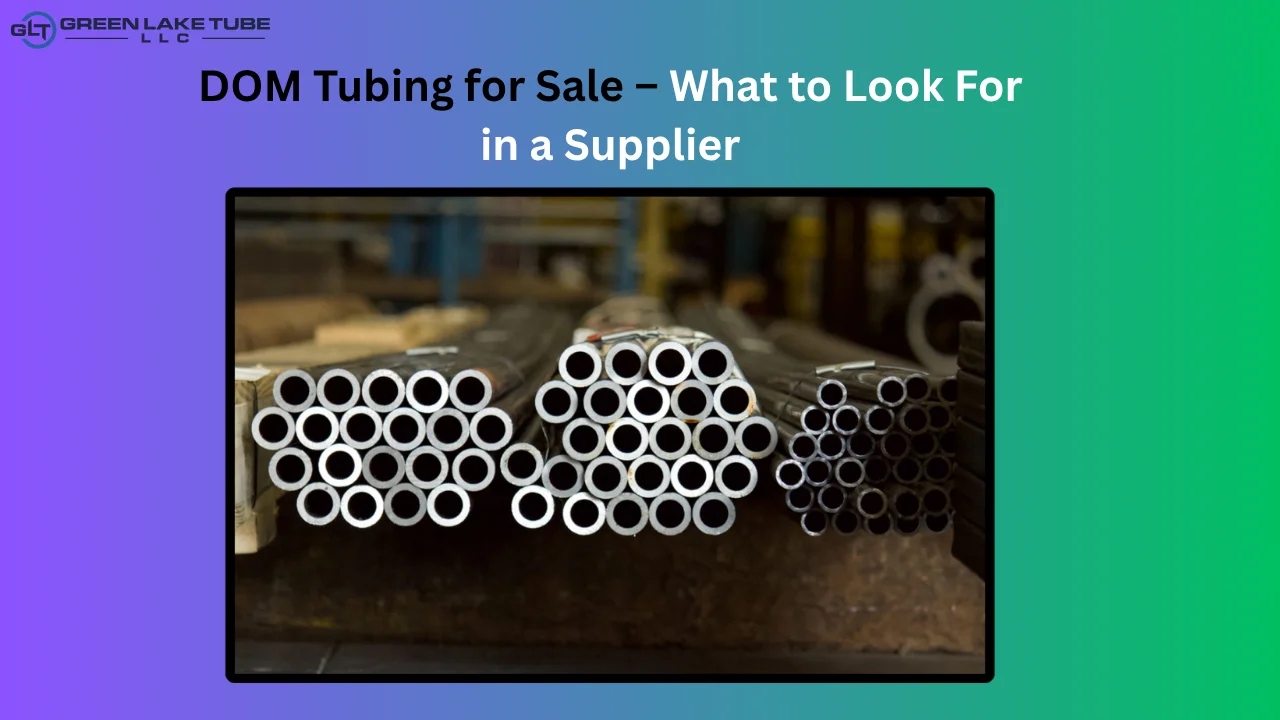
DOM Tubing for Sale – What to Look For in a Supplier
When sourcing steel DOM tubing or ERW, make sure your supplier offers:
- Mill test reports (MTRs) for quality verification
- Custom cutting to reduce waste
- Multiple size and shape options
- Fast delivery times
At Green Lake Tube, we provide precision-cut ERW and DOM tubes for industries across North America—meeting ASTM and ISO standards.
FAQ – ERW & DOM Tubing
What is ERW pipe?
ERW (Electric Resistance Welded) pipe is made by welding the edges of steel coil using electrical current and pressure, creating a strong seam.
What is DOM tube?
DOM (Drawn Over Mandrel) tubing starts as ERW but is cold drawn for improved strength, precision, and surface finish.
Which is better for a roll cage—ERW or DOM?
DOM is generally preferred for roll cages due to its higher tensile strength and better impact performance, but ERW can be used for non-critical areas.
What’s the difference between welded vs seamless tubing?
Welded tubing is made from steel coil with a seam, while seamless tubing has no seam and is made from a solid billet. DOM is a type of welded tubing with improved properties.
How is DOM tubing made?
It’s ERW tubing that’s drawn through a die and over a mandrel to improve dimensional accuracy and surface finish.
Final Thoughts
Whether you need 1.75 tube for a roll cage, seamless hydraulic tubing for industrial systems, or ERW rectangular tube for structural builds, understanding the differences between ERW, DOM, and seamless will save you both money and headaches.
ERW steel tube delivers cost efficiency, availability, and strong performance for most fabrication jobs. DOM steel tubing steps in when precision and extra strength are required. And seamless tubing serves in high-pressure or safety-critical roles.
At Green Lake Tube, we help fabricators, race teams, and manufacturers get the right tubing for the job—cut to size, quality-tested, and delivered fast. Contact us today to discuss your project and get a quote you can trust.

