
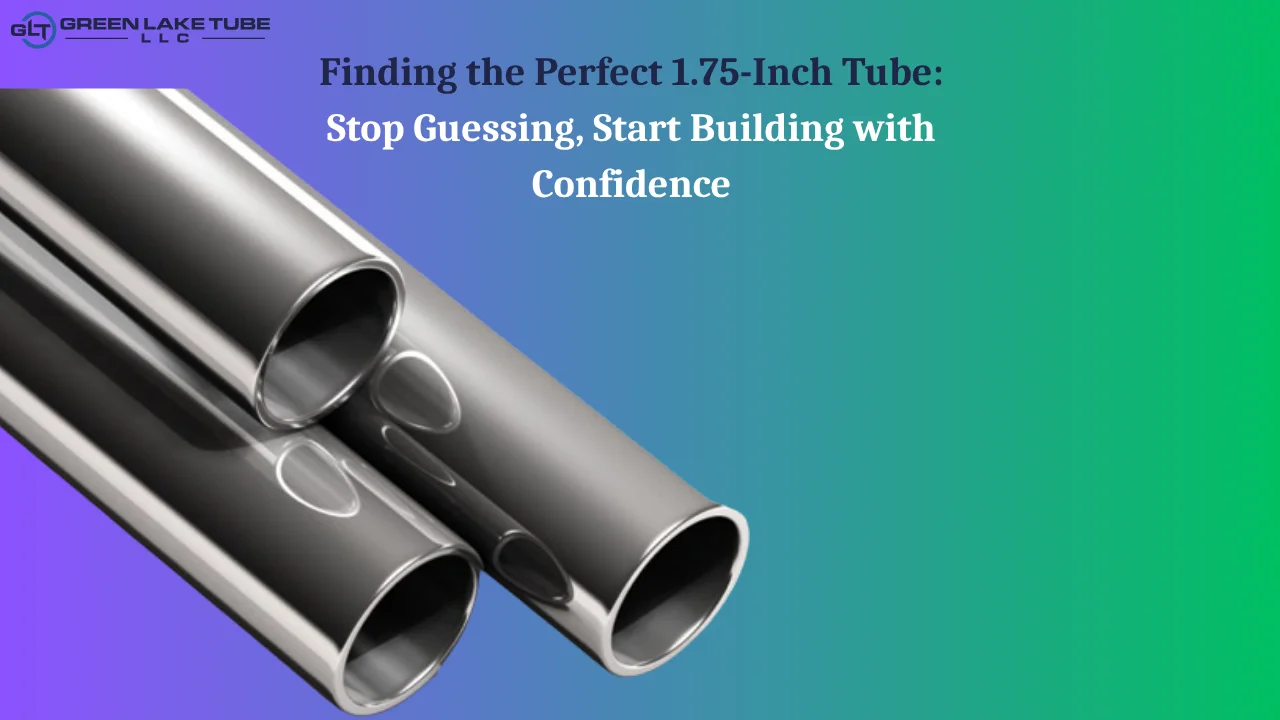
Every project—from crafting a sturdy bed frame to reinforcing machinery—runs into the same frustrating snag: you know you need a 1.75 inch tube, but there are countless options—square, round, steel, welded—how do you choose? You’ve probably searched “1.75 square tubing”, “1.75 pipe”, or “1.75 OD pipe”, only to be bombarded with technical specs and confusing terms. Let’s end that wasted time. Here’s the guide that cuts through the noise and gives you exactly what works.
What Does “1.75 Inch” Really Mean?
To choose the right material, you first need to understand how 1.75 inch measurements are described in different product types—whether it’s tubing, pipe, or square tube.
Understanding Tube vs. Pipe vs. Square Tube
- 1.75 in pipe – generally indicates a tube with a 1.75 inch outer diameter (OD).
- 1.75 tubing / 1.75 tube – generic terms; could reference square or round.
- 1.75 square tubing, 1.75 square tube – specifically 1.75 × 1.75 inch exterior in square form.
- 1.75 ID steel pipe – if someone refers to ID, they mean inner diameter—critical for fluid flow or inserts.
- 1.75 steel tube – usually refers to round tubing unless stated square.
- 1.75 OD pipe – confirms the outer dimension.
- 1.75 ERW tubing – Electric Resistance Welded tubing, a cost-effective manufacturing type.
By knowing exactly which dimension matters—outer vs. inner—and whether you need square or round, you can skip down the specs much faster.
Why Choose Square vs. Round? Real-World Examples
Let’s start by looking at 1.75 × 1.75 inch square tubing—a popular choice when strength, clean lines, and structural stability matter most.
Square Tubing (1.75 × 1.75 inch)
- Offers excellent rigidity, great for frames, brackets, architectural details.
- Example: A garage shelving unit built with 1.75 square tubing stays solid under load.
- ASTM grades A513 (mechanical) and A500 (structural) are common—A513 used in appliances and machinery, A500 in construction and sign supports.
Round or Standard Pipe (1.75 OD)
- Ideal for fluid systems, railings, or any application needing smooth curves.
- If you see “1.75 in pipe” or “1.75 OD pipe”, you’re on the right track for cylindrical needs.
ERW Tubing
- 1.75 ERW tubing is manufactured via electric resistance welding, making it affordable yet strong—suitable for general fabrication.
Quick Comparison Table
| Type | Best For | Strengths | Key Spec to Know |
| 1.75 square tubing | Frames, supports | High rigidity | 1.75 × 1.75 exterior dimension |
| 1.75 OD round tube/pipe | Fluid systems, rails | Smooth curves | Outer diameter = 1.75 in |
| 1.75 ID pipe | Insert fitting, piping | Internal clearance | Inner diameter = 1.75 in |
| 1.75 ERW tubing | General fabrication | Cost-effective manufacturing | OD and weld type matter |
Real-World Application Stories

- DIY project: A homeowner used 1.75 square tube A500 for a backyard pergola. The setup resisted bending in high winds and held up for years.
- Automotive repair: A mechanic chose 1.75 ERW tubing for a custom suspension brace—welded easily and kept the frame stiff under stress.
- Appliance fabrication: A manufacturer used 1.75 square tubing in an A513 grade for machine frames—welded cleanly, retained tight tolerances.
These examples show how knowing your exact dimension, form, and grade puts performance and peace of mind on your side.
FAQ’s:
Q1: What is 1.75 square tubing used for?
Ideal for structural framing, industrial maintenance, truck beds, general fabrication, and reinforcing equipmen.
Q2: Is 1.75 OD pipe the same as 1.75 in pipe?
Yes. Both refer to the same outer diameter—1.75 inches.
Q3: How strong is square vs. round tubing?
Square tubing delivers greater rigidity and resistance to bending—a common reason fabricators choose it over round for frames.
Q4: What’s the difference between A513 and A500 square tubing?
A513 is a mechanical grade—used in automotive, solar, appliances. A500 is structural—ideal for buildings, towers, sign supports.
Q5: What does 1.75 ERW tubing mean?
ERW stands for Electric Resistance Welding, a production method that creates tubing with consistent wall thickness and good weldability.
Before You Order: Practical Pre-Buy Checklist
- Confirm your dimension: Do you need 1.75 OD, 1.75 ID, or 1.75 × 1.75 square?
- Choose your grade: A513 for machining parts, A500 for load-bearing builds.
- Check wall thickness: Even at 1.75 inches, thickness affects strength and weight.
- Ask for cut-to-size: Many suppliers can pre-cut lengths—for example, OnlineMetals offers 1.75″ × 0.12” square tube by the foot.
- Weldability matters: If welding is involved, test a sample or confirm compatibility.
Bullet-Point Takeaways
Key considerations when choosing 1.75-inch tubing or pipe:
- Choose square vs round based on load and design needs.
- Confirm whether the spec refers to OD or ID.
- Select proper steel grade: A513 for mechanical/machining, A500 for structural.
- Wall thickness directly affects strength—0.083″, 0.120″, etc.
- ERW format offers affordable, consistent tubing.
Comparison: 1.75 Square Tubing Options

Wrap-Up: Build with Clarity, Not Confusion
Your projects deserve materials you can trust. Whether you searched 1.75 pipe, 1.75 OD pipe, 1.75 square tube, or 1.75 steel tube, you now know how to decode what you actually need—square or round, OD or ID, ERW or structural. You can match strength to design requirements and weed out guesswork before buying. Shop confidently: Green Lake Tube stands behind its name—expert in metal tubing since 2010.
Final Thoughts & Next Steps
- Pin down the exact dimension you need—don’t rely on assumptions.
- Choose the correct tubing type and grade for your application.
- Order sample cuts to test fit-weld-strength.
- Reach out to trusted suppliers like Green Lake Tube—they’re metal tubing specialists, ready to help you get it right.
Ready to get started? Visit Our site today and explore our full range of 1.75-inch tubing and pipe options, cut to your exact specifications. Your project deserves the right materials—let’s make it happen.

